Camp’n & Charge’n
There is nothing quite like pulling into a quiet campground after a long day on the trails, matching the rugged beauty of the outdoors with the quiet utility of an electric truck. But for an electric nomad, setting up camp involves an extra, incredibly rewarding step: tapping into the grid.

In early 2017, Volkswagen's I.D. BUZZ concept teased an exciting new class of electric campers. I obsessed over the idea of a vehicle that could serve as both an economical daily driver and a weekend warrior rig—especially the ability to score a free "virtual tank of gas" by plugging into 50-amp RV spots while camping.
Because the US version of the microbus was delayed until mid-2024, I looked for other ways to "Weaz the Juice." While overlanding went mainstream and Ford launched a gas-powered Transit Trail Van, there was still no word on an electric version. Everything clicked when a buddy told me about the Go Fast Camper. It was just a matter of finding the right truck to put underneath it. I settled on the Ford F150 Lighting, bought both the same day, and started this electric overland journey.
Precious KiloWatts
If you are planning to utilize an RV campsite to handle your vehicle's power needs, understanding the local infrastructure is key. Most modern locations, including your standard KOA properties, and many sites found on apps like Hipcamp offer dedicated 50-amp hookups. This map shows just some of the places in and around North Carolina where I like to grab a charge, a nap and a shower, close to my favorite activities like Snowboarding, Onewheeling, and Stand Up Paddle-boarding.

I love to roll into an RV camp spot after dark, point the back end towards something interesting, and the next morning I wake up with a full charge and a view.
Understanding the Campground Grid
A standard 50-amp RV receptacle utilizes a NEMA 14-50 configuration, supplying 240 volts of electricity (like a dryer). When you plug the truck directly into this circuit using a compatible Level 2 mobile charger, the vehicle safely draws around 32 amps to 40 amps of continuous current.
In real-world terms, this translates to a steady power delivery of roughly 7.6 kW to 9.6 kW.
The Real World Takeaway
What does that math actually mean for your trek? At those charging speeds, you will see your driving range increase by about 15 to 20 miles for every single hour the truck remains plugged into the pedestal. This is where it’s important to ensure that the site is “50-amp” or “Full Hookup” because a standard, 110v wall outlet would take at least four full days to match a one night 50-amp charge.
In my Is it Cheaper? blog I shared that I spend about 24 cents per mile on trips and much less for my daily commute, so I can spend about $50 for a fast charge on a trip. Many electric campsites start at $60 and have amentities that can make you very cozy, so if you have the time, it’s a great bargin.

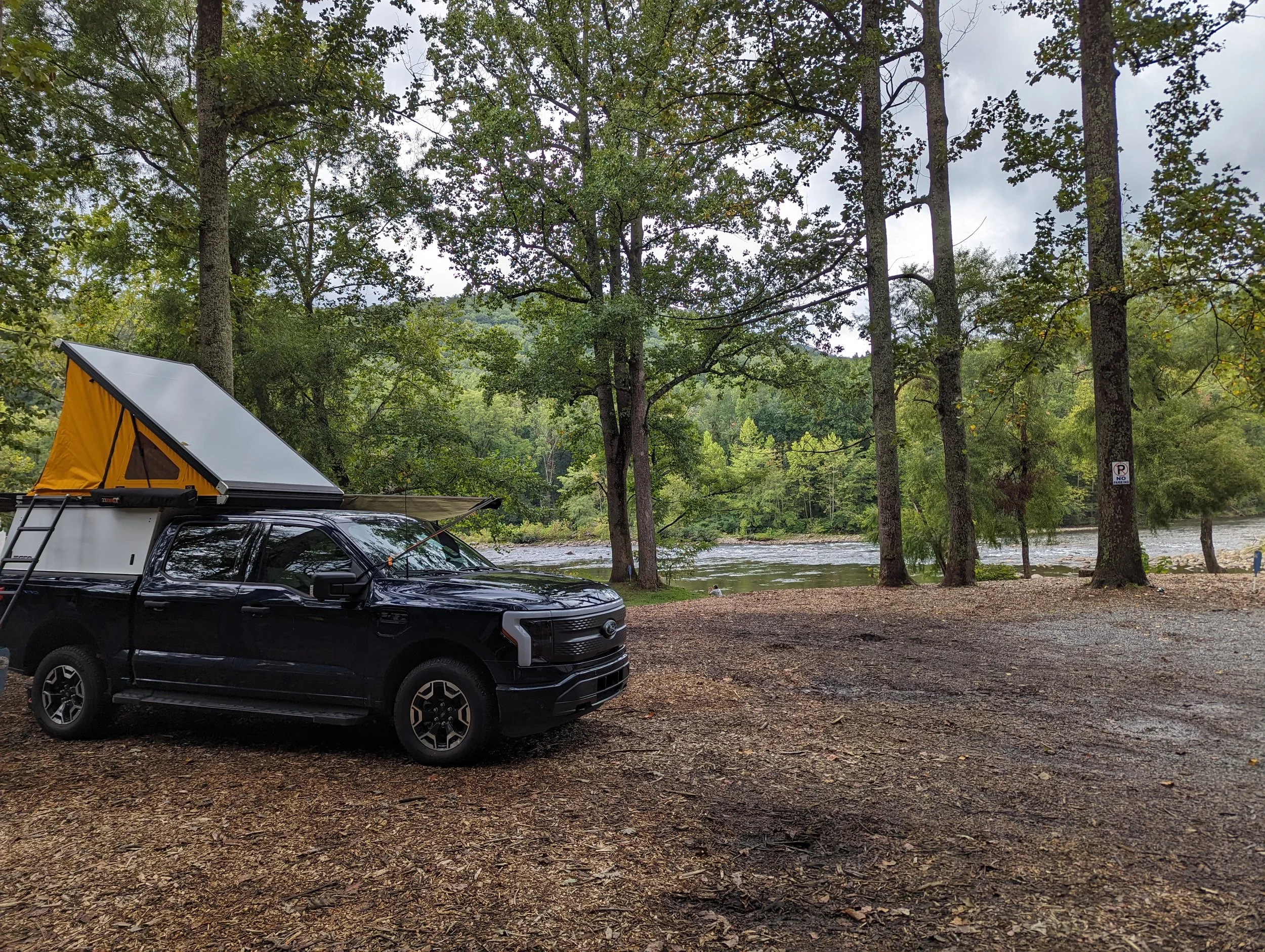


This also means while you are completely unplugged from the matrix—enjoying a warm camp meal, lingering by the fire, or sleeping off a long day of paddleboarding—your truck is quietly doing the heavy lifting. Like I said in my What I Wish I Knew? blog, you don’t really want to fast charge to 100%. By opting to slow charge, by the time the mountain sunrise hits your tent the next morning, your battery capacity will be fully replenished and ready for whatever rugged trails lay ahead. It is clean, low-friction, and gives you a massive safety buffer without ever needing to reroute your adventure toward a commercial highway fast charger.
